
What Is a Consumer Trial?
How Health Brands Validate Products Without Clinical Studies
CONSUMER HEALTH STUDIES
4/13/20265 min read
Introduction
You've formulated a supplement. You've tested the skincare line. You believe in what you've built, but when a retailer asks for proof, or a customer wants to know "does this actually work?", what do you say?
For most health brands, the answer is a vague gesture toward ingredients and hope.
Clinical studies sound like the gold standard, but they're also expensive, slow, and designed for pharmaceutical drugs, not consumer wellness products. The good news: there's a more practical, brand-ready alternative that's gaining serious traction in the supplement, skincare, and wellness space.
It's called a consumer trial, and it might be the most underused tool in a health brand's marketing arsenal.
What Is a Consumer Trial?
A consumer trial is a structured study in which real people use your product under defined conditions, and their experiences are measured and documented.
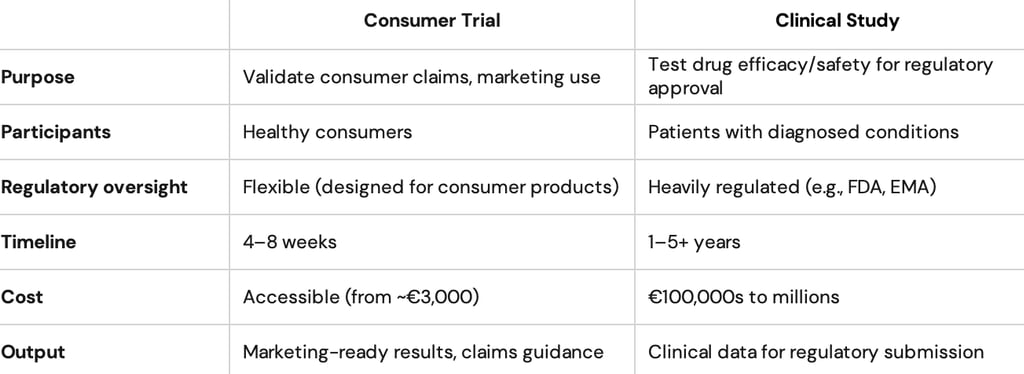
Unlike a clinical trial, which is regulated, drug-focused, and built to satisfy pharmaceutical approval bodies, a consumer trial is designed to answer the questions that actually matter for a consumer health brand:
Does this product produce noticeable results in real users?
What outcomes can we honestly claim in our marketing?
How do consumers perceive the product's effectiveness, taste, texture, or tolerability?
The result is a body of evidence: participant data, observed outcomes, and a set of findings you can confidently reference in your marketing, retailer pitches, and product packaging.
Consumer Trials vs. Clinical Studies: What's the Difference?
This is where a lot of brands get confused, so let's be direct.
Clinical studies are built for drugs. Consumer trials are built for brands.
If you're selling a collagen supplement, a probiotic, or a topical retinol, and you're not making disease claims, a consumer trial gives you the evidence you need without the overhead of a clinical programme.
What Can a Consumer Trial Actually Prove?
This depends on your product, your study design, and what outcomes you're measuring, but consumer trials can generate legitimate, citable evidence for claims like:
"9 out of 10 participants reported improved skin hydration after 4 weeks"
"Participants experienced a significant reduction in bloating within 2 weeks"
"87% of users said they felt more energised after 30 days"
These aren't made-up marketing lines. They're findings from structured data collection, surveys, validated assessment tools, self-reported outcome measures, and in some cases objective measurements like skin hydration scans or blood markers.
The key is that the study is designed to produce claims you can actually use. That's what separates a well-run consumer trial from a generic customer survey.
Who Uses Consumer Trials?
Consumer trials aren't just for large supplement brands. They're increasingly being used by:
Supplement startups validating a new formula before a major launch, so they can go to market with confidence and back their claims from day one.
Skincare brands gathering efficacy data to satisfy increasingly sceptical retail buyers who want more than "clinically inspired" on the box.
Wellness and longevity companies building a science-backed content strategy, using study results in blog posts, email campaigns, and social proof.
Established brands looking to defend and strengthen existing product claims or respond to a competitive market that's raising the evidence bar.
In short: if you make a health-related claim about your product, a consumer trial gives that claim teeth.
How a Consumer Trial Works (Step by Step)
The process varies by provider and study type, but a well-structured consumer trial typically follows this path:
1. Define your goals
What claims do you want to support? What outcomes matter most to your audience? This shapes everything from study design to the questions participants are asked.
2. Design the study
A study specialist works with you to define the participant profile, study duration, measurement tools, and data collection methods. This is the most critical step, a poorly designed study produces unusable data.
3. Recruit participants
Participants are recruited to match your target consumer. They receive the product and follow defined usage instructions over a set period, typically 4–8 weeks.
4. Collect and analyse data
Outcomes are measured at defined intervals using validated tools. The data is then analysed and interpreted in context of your product and goals.
5. Receive your results report
You receive a clear, structured report with findings, statistical analysis, and guidance on how to translate results into compliant marketing claims.
6. Put it to work
The results live on your website, in your retailer pitch deck, in your PR materials, and in your ad copy. Done well, one study fuels your brand narrative for years.
What Makes a Consumer Trial Credible?
Not all consumer trials are equal. If you're investing in one, these are the factors that determine whether the results hold up to scrutiny:
Participant sample size, too few participants and the data isn't statistically meaningful. A good trial will be sized appropriately for the outcomes being measured.
Validated measurement tools, outcomes should be measured using established, recognised methods, not ad hoc questionnaires.
Transparent methodology, the study design should be documented and reproducible. If you can't show how the study was run, you can't defend the results.
Appropriate claims guidance, the findings should be translated into claims that are honest, proportionate to the data, and suitable for your market.
Working with a specialist provider, rather than running an informal test yourself, is what turns raw participant feedback into evidence that stands up.
The Real Value: More Than Just Marketing Claims
Yes, a consumer trial gives you marketing claims. But the value runs deeper than copy.
Retailer confidence. Buyers at health retailers are seeing more brands, more claims, and more scepticism from their customers. A brand that arrives with study data stands out immediately.
Customer trust. "Clinically tested" is everywhere. "Here's what 120 real users experienced over 6 weeks" is specific, credible, and far more persuasive.
Regulatory readiness. As consumer health regulation tightens in markets like the EU and UK, having documented evidence behind your claims is no longer just good practice, it's smart risk management.
Product development. Consumer trial data tells you what's working, what isn't, and sometimes what to improve. That feedback loop is valuable beyond the marketing output.
Is a Consumer Trial Right for Your Brand?
A consumer trial makes sense if you:
Make or intend to make efficacy claims about your product
Are preparing for a retail launch or retail buyer conversation
Want to differentiate your brand in a crowded, claims-heavy market
Are building a long-term, science-backed brand narrative
Have a product you genuinely believe performs, and want to prove it
It may not be the right next step if your product is pre-formulation, if you're still iterating on the formula, or if your primary goals are taste/texture rather than efficacy outcomes. (Though even in those cases, a consumer perception study can be valuable.)
The Bottom Line
A consumer trial is one of the most practical, brand-relevant investments a health product company can make. It's not a clinical trial, it doesn't need to be. It's structured evidence, generated by real users, that supports what you already believe about your product.
In a market where every brand shouts about quality ingredients and innovative formulas, consumer trial data is how you show your work.
10:34
Ready to find out what a consumer trial could do for your product?
We work with supplement, skincare, and wellness brands at every stage, from early validation to large-scale studies. Get in touch for a free consultation →
Validence Labs
We specialize in consumer insight studies and biomarker-supported consumer research for supplements, skincare, wellness, and functional products. Based in Germany and serving clients across the world, we help brands validate claims, understand customers, and make data-driven decisions.
Contact
info@validencelabs.com
© 2026. All rights reserved.